
TL;DR
Ensuring SDRs are in control of their success is critical to building a high-performing inbound demand generation funnel. Keeping metrics tied to the activity they can control avoids conflict, increases transparency, and builds ownership.
Building an Inbound SDR Comp Plan that meets the needs of the business, is competitive enough to secure the best talent, and motivates the SDR in the right way can be a challenging juggling act.
If your growth is heavily tied to an inbound funnel, the wrong comp plan and commission structure can cause havoc with your pipeline and revenue goals. Having built successful inbound funnels that consistently exceed annual targets, I’ve experimented with a number of different comp plan strategies; so let me share some of what I’ve learned over the years, and explain the structure that’s been most successful for me.
This post is by no means a definitive guide, and that’s because there is no one right answer, or cookie-cutter approach to building an effective SDR Comp Plan. Factors such as the CTAs being used on your website, structure of the sales team and sales funnel, and even your ICP, will influence your approach. However, it’s important to understand the benefits and limitations of the most common approaches so that you can make an informed decision.
Your SDR Comp plan is built from two components; base salary and variable pay. This post will cover the variable pay element; which is the most important aspect for driving success. For context, typically I would suggest running a 70:30 mix (base:variable). Many will argue for a 60:40 mix (or even lower), but personally I see that as too high risk for an SDR. Sure, I want them to deliver and perform, but I also want them to have some financial security. Happiness, fulfilment, and security is a far better motivator IMHO.
SDRs must be in control of their success
When determining the comp plan and variable pay element, the most important question to ask yourself is, “what is the key objective, and can I track it?”.
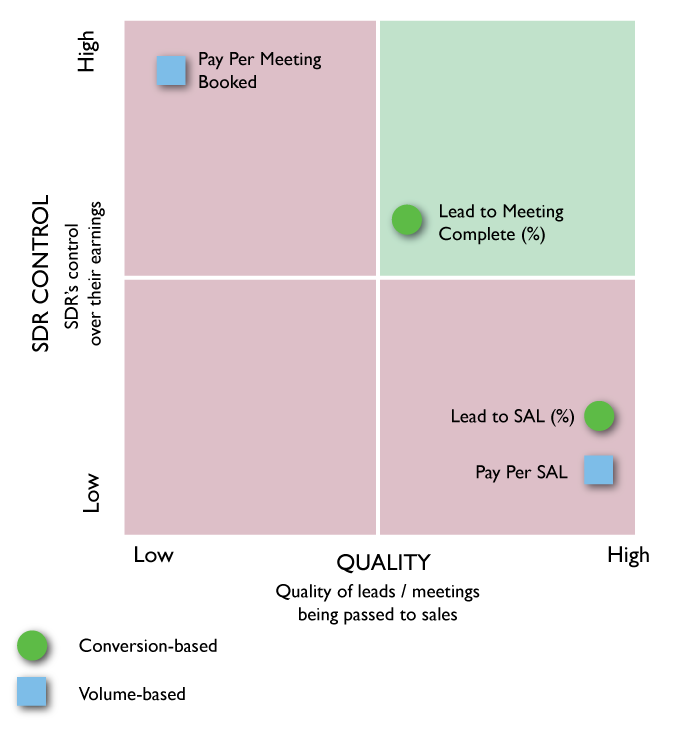
Much of the conflict that arises when building an effective SDR Comp Plan centers around building targets that are a.) in the control of the SDR (e.g. not penalizing them for factors that they can’t control), while b.) also ensuring that everyone is focussed on quality and prioritizing the right leads. Finding the balance between these variables is key.
This trade-off hinges between two types of SDR Comp Plans; volume-based vs conversion-based.
Volume vs Conversion-based SDR Comp Plans
VOLUME BASED
A volume-based plan is often adopted by organizations looking for a simple approach. Typically it’s based around a count of leads, meetings, or opportunities, making it simple to measure. However, there are several key limitations; including poor scalability, which means it’s difficult to maintain this approach as your organization and inbound funnel grows.
Payment Per Meeting
I see many plans built around the count of qualified leads being passed to an AE; e.g. a payment per sales meeting booked. It might work for an outbound team, but it’s not as effective for inbound, and will typically drive the wrong behavior. It might seem like a logical starting point, but even if you’re just starting out, this approach is not recommended.
Benefits:
- It’s a simple metric, based on a count of meetings being booked from a pool of leads.
- Easy to measure.
Limitations:
- Not all leads are equal. Paying per qualified lead generally drives the wrong behavior. SDRs will potentially chase the “quick wins” rather than prioritizing the leads that meet your ICP and have a better chance of progressing into the sales funnel.
- It doesn’t scale well. Changes in your funnel mix (e.g. average deal values) or in your top of funnel demand generation programs (e.g. fewer website visits), mean that the target count of opportunities being passed to sales by your SDR team may have to change. You need the flexibility in your plan to do that without rewriting or renegotiating commission structures; this approach makes that hard.
Payment Per Opportunity (SAL)
Like Payment per Meeting this is built around a volume metric, but extends responsibility further into the sales cycle by only rewarding leads that make it through to a pipeline opportunity. This overcomes the issue of bad SDR behavior and focussing on a raw lead count vs focussing on the leads most likely to progress in the sales funnel. However, it’s still something of a blunt instrument and can penalize the SDR by putting 100% of their earning potential into the hands of the AE progressing the lead to an opportunity.
Benefits:
- It’s a simple metric, based on a count of opportunities.
- Easy to measure.
- Focuses attention on high quality leads that have the best chance of progressing.
Limitations:
- SDRs have little control over their earnings.
- AE’s may vary in skills and performance, with some pushing more leads to an opportunity than others. This can create conflict.
- Can create artificial pipeline, with AEs progressing to opportunity just to help SDR’s achieve their target (crazy, but I’ve seen it happen).
CONVERSION BASED
% Lead to Demo Completed
A common and popular approach to SDR Comp Plans. This is based on the percentage of leads that the SDR is able to convert to a qualified sales meeting, that actually completes. It balances volume with some degree of quality, and ensures the SDR remains engaged until the sales meeting actually happens (working to reschedule any meeting no-shows etc).
Benefits:
- Scales easily and is not so dependent on web traffic fluctuations, or other top-of-funnel variables.
- Maintains a degree of quality by focussing SDRs on leads that are engaged, and show enough intent to actually attend and complete the sales meeting.
Limitations:
- You will need to know the conversion % that is required in order to achieve a pipeline goal. For an overview of how to do that, check out this previous guide.
- Even meeting the conversion goal might not achieve a pipeline target if resulting opportunities offer deal sizes below your average.
- If you see a high percentage of junk leads (e.g. bounces, poor use cases, job seekers), then conversions can be impacted. In this scenario you may look to measure the conversion against MQLs only.
% Lead to Opportunity (SAL)
Measuring the percentage of leads that make it through to a pipeline opportunity, this approach prioritizes quality above all else. However, like Payment per Opportunity (SAL) it takes a lot of the control away from the SDR, by putting 100% of their earning potential into the hands of the AE, and their ability to progress leads to an opportunity.
Benefits:
- Keeping SDR teams focused on a highly targeted ICP and account list
Limitations:
- SDRs have little control over their earnings.
- AE’s will vary in skills and performance with some pushing more leads to an opportunity than others, this can create conflict.
- Delays in AE availability can reduce the chances of leads progressing to an opportunity. It may be unfair to penalize an SDR for this.
My preferred approach
This post is not going to offer you a definitive guide. However, the analysis of volume vs conversion based SDR Comp Plans should have provided you with an outline understanding of where to begin. In fact, you may look to create highly customized plans that combine more than one of the approaches described above. For example; % Lead to Demo Completed, but with an additional component to reward pipeline contribution.
However, having experimented with a number of different approaches to SDR Comp Plans, I know all too well that they can quickly become over-engineered, to the point that SDRs have no real transparency in how they can earn.
That’s why, in most cases I land on simply deploying % Lead to Demo Completed.
For me, % Lead to Demo Completed strikes the best balance between volume and quality; keeping SDR’s focussed deeper into the funnel, and keeping targets almost exclusively within the control of the SDR.
Should I pay SDRs if they don’t achieve 100%?
Again, this goes back to keeping your SDR team financially secure and fulfilled in their roles. Continual under-achievement is, of course, a cause for concern, but this is better managed by placing that SDR on a PIP and if necessary, replacing them, rather than a restrictive commission plan that only pays out at 100%.
Find a balance that’s fair; for example the SDR might qualify for variable pay once they are at 80% of their target. Payments are then run as a multiplier of their achievement.
Adding Accelerators
If your SDR comp plan is correctly tied to pipeline, there should be no barrier to offering accelerators beyond their OTE. In fact, this should be encouraged, particularly if variable pay is calculated on a quarterly basis. In such scenarios, the opportunity exists for an SDR to meet their OTE target before the end of quarter. Where that happens, you don’t want the SDR to take their foot off the gas. Instead, an accelerator offers the chance for the SDR to continue earning for over-performance.
Of course, it’s still best practice to cap this accelerator (for your own financial planning). I would recommend setting the limit at 150% of their target.
Summary
- The wrong comp plan and commission structure can cause havoc with your pipeline and revenue goals.
- Conflicts often exist between volume and quality when building an effective plan. There is always trade-off between the two.
- When determining the comp plan and variable pay element, the most important question to ask yourself is, “what is the key objective, and can I track it?”.
- There is no one right answer, or cookie-cutter approach to building an effective SDR Comp Plan. Factors such as the CTAs being used on your website, structure of the sales team and sales funnel, and even your ICP, will influence your approach.
- Ensuring SDRs are in control of their success is critical. Keep metrics tied to activity they can control. Typically, an SDR has less control as leads progress further into the sales cycle.
 Unlock the secrets of SaaS growth
Leave a comment