
Each day we are guided by iconography. It’s become part of our lexicon – from road signs to desktop icons. In most cases, an iconographic approach is an efficient means of conveying complex information in a more visual and universal way, and in a way that’s removed from language barriers.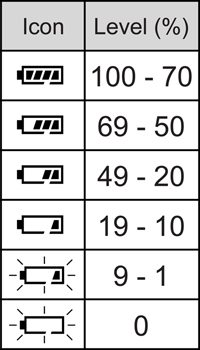
Even across platforms, commonality between icons has naturally evolved to benefit the consumer. In the world of computing, an envelope often represents email, a speaker for volume control, a key or padlock for security, etc.
However, there are some images and symbols that we’ve lived with for many years, that we take for granted and that we do not question. But how effective are they at conveying important information?
Take the battery icon. Almost any rechargeable device – from phones to cameras – represents remaining power in the form of a ‘discharging’ battery. Typically changing from green to red. But does this tell you everything you need to know. Principally, how much longer can I use the device before I need to recharge.
If the battery shows half empty, how many minutes, or hours, of use do you actually have left? Would you know? Do you need to know?
This occurred to me a few weeks ago when I bought a new electric razor in advance of a week and half long business trip to the US. It was rechargeable (I didn’t want to pack and carry a mains lead / adapter etc) and the packaging even made a claim that a battery indicator would mean I knew how much charge I had left.
But is that really of value to me? ‘Charge’ is just an arbitrary concept. What I actually wanted to know is how many minutes of use I would have left. Could I use it daily or should I ration its use? This was a new product and I had no idea how long a full charge would give me, or how many minutes a half-charged battery icon would deliver.
Even for products that you’ve owned for years and use daily, like your mobile phone, do you know?
The problem is even more apparent in the consumer electronics market when battery performance is variable according to use. An open 3G connection on your phone, Bluetooth or WiFi enabled, flash photography; all vary the stated standby and use estimates.
Battery indicators also vary between brands. I’ve had a Nokia that, once the battery shows its final bar, gave me less than 30 minutes. My current BlackBerry will do a couple of hours with one bar left. If I churn from one brand to another, where should I set my expectations?
One consumer ‘product’ that understands this is the motor car. On many modern vehicles, the traditional analogue fuel gauge is supplemented by a ‘range’ indicator. I frequently refer to this in my car. Again, even after 3 years of ownership I’d struggle to tell you accurately how far half a tank of fuel will get me at motorway cruising speeds. My range indicator will give me a ‘relatively’ accurate range in miles and vary according to how hard I drive the car; far more useful in the real world.
As battery performance struggles to keep pace with the demands of touchscreens, backlight displays, 3G connections, faster processors and more, surely a ‘range indicator’ would be of value to the mobile consumer? A large number of customer care calls from mobile users relate to battery performance. In many instances it’s because the consumer was not aware of the strain that open 3G, WiFi and Bluetooth connections place on battery life.
NB – apparantly the iPhone myBatteryLife app will do exactly what I’ve been describing. 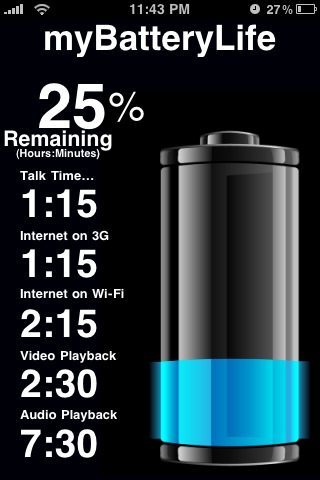


 Unlock the secrets of SaaS growth
Leave a comment